
Can You Patch a Tire With a Nail in It? Repairable vs. Unrepairable Tire Punctures
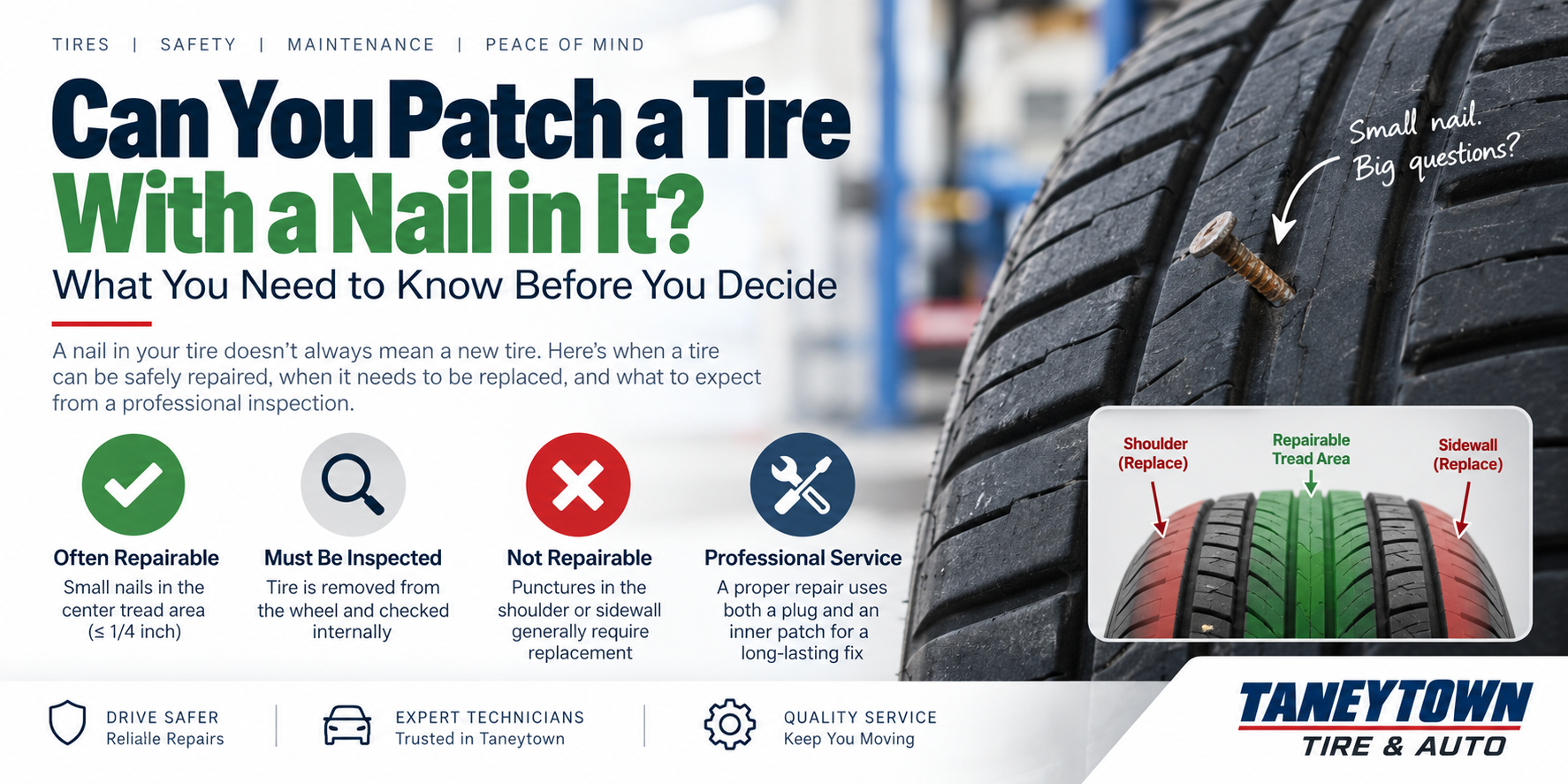
Finding a nail in your tire does not automatically mean you need a new tire. Many nail punctures can be safely repaired if the hole is small enough, located in the repairable tread area, and the tire has not suffered additional internal damage.
The location of the puncture matters just as much as its size. A small nail through the center of the tread may be repairable, while the same nail near the shoulder or sidewall usually requires tire replacement.
A tire also needs to be removed from the wheel and inspected internally before a permanent repair can be considered safe. Taneytown Tire & Auto provides professional tire repair and installation services for drivers throughout Taneytown and Carroll County.
Can You Patch a Tire With a Nail in It?
Yes. A nail puncture can generally be repaired when it is no larger than 1/4 inch, is confined to the repairable tread area, and has not caused internal or sidewall damage.
For passenger and light-truck tires, industry repair guidelines generally limit puncture repairs to holes 1/4 inch (6 mm) or smaller.
The puncture must also remain within the central tread area covered by the tire’s belts. Damage extending into the shoulder or sidewall should not be repaired.
A technician must remove the tire from the wheel because the outside of the tire does not reveal whether driving while underinflated has damaged the inner liner, sidewall, or internal structure.
Where Can a Tire Puncture Be Repaired?
The repairable area is the central tread or crown of the tire. The shoulder and sidewall are not considered safe puncture-repair areas.
A tire’s tread is reinforced by steel belts designed to withstand the stresses generated as the tire rolls over the road.
The shoulder is the rounded transition between the tread and sidewall. This area flexes substantially during driving, which makes a permanent puncture repair unreliable.
The sidewall flexes even more.
As a result:
- Center tread puncture: Often repairable
- Outer tread near the shoulder: May be unrepairable
- Shoulder puncture: Replace the tire
- Sidewall puncture: Replace the tire
If a puncture channel enters the tread but angles internally toward the shoulder or belt edge, the tire may also need replacement.
How Close to the Sidewall Can a Nail Be Patched?
There is no universal number of inches from the sidewall that guarantees a puncture is repairable. The important boundary is whether the injury remains completely inside the manufacturer’s approved tread repair area.
Drivers sometimes hear rules such as “one inch from the sidewall,” but tire construction and tread width vary.
The actual repairable area depends on where the tire’s belt package ends and the shoulder begins.
That means a technician should evaluate the puncture location rather than simply measure from the visible edge of the tire.
If there is doubt that the injury extends into the shoulder or belt-edge area, replacement is generally the safer choice.
How Big of a Nail Hole Can Be Patched?
Passenger and light-truck tire punctures generally must be 1/4 inch (6 mm) in diameter or smaller to qualify for a standard puncture repair.
A typical nail or screw often produces a hole smaller than this limit.
Larger objects can damage more of the tire’s tread structure or steel belts, making a reliable permanent repair impossible.
The visible object does not necessarily indicate the true size of the injury. A nail may enter at an angle or move while the vehicle is driven, enlarging the puncture channel.
The tire should therefore be inspected after the object is removed rather than judged solely by the diameter of the nail head.
Is a Tire Plug the Same as a Patch?
No. A plug fills the puncture channel, while a patch seals the tire’s inner liner. A proper permanent repair addresses both parts of the injury.
A puncture creates two separate problems.
First, there is a hole through the tire’s tread and belt structure. Second, there is an opening in the airtight inner liner.
A plug alone may fill the external hole, but does not properly seal the inner liner. A patch alone can seal the inside, but leaves the puncture channel exposed to moisture.
Water entering the puncture channel can reach the tire’s steel belts, contributing to corrosion.
For this reason, proper professional puncture repairs normally use both a rubber stem and an inner liner patch, often combined into a single patch-plug repair unit.
Are Tire Plugs Safe?
A plug installed from the outside without removing the tire is not considered a complete, permanent tire repair.
Emergency tire plugs can temporarily stop an air leak, but they do not allow the technician to inspect the inside of the tire.
That distinction is important because a tire that has been driven while nearly flat may have significant internal sidewall damage while still looking relatively normal from the outside.
For a permanent repair, the tire should be removed from the wheel, inspected, and repaired from the inside using an approved repair method.
Why Does the Tire Have to Come Off the Wheel?
The tire must be removed so a technician can inspect the inner liner, sidewalls, belts, and puncture channel for hidden damage.
When a tire loses air pressure, its sidewall flexes much farther than it was designed to.
Driving even a relatively short distance on a severely underinflated tire can generate heat and damage internal tire components.
Possible signs include:
- Inner liner abrasion
- Sidewall cracking
- Rubber debris inside the tire
- Damaged cords
- Belt separation
- Heat damage
None of these conditions can be reliably evaluated with the tire still mounted.
This is why a nail that appears to be a simple repair from the outside can sometimes result in a replacement recommendation after inspection.
Can You Repair a Nail in the Sidewall?
No. A nail puncture in the sidewall should not be patched or plugged as a permanent repair.
The sidewall constantly flexes as the tire carries vehicle weight and absorbs bumps.
A repair placed there experiences repeated deformation that a tread-area repair does not.
Sidewalls also lack the same belt reinforcement found beneath the central tread.
If a nail, screw, piece of metal, or other object penetrates the sidewall, the appropriate solution is generally replacement.
Drivers who need replacement tires can use Taneytown Tire & Auto’s online tire shop to search tires by vehicle, size, and driving needs.
Can You Patch a Nail in the Tire Shoulder?
No. Punctures in the shoulder or injuries extending into the belt-edge area are generally not repairable.
The shoulder may still have visible tread blocks, which can make it appear to be part of the normal repairable tread area.
Structurally, however, the shoulder is where the reinforced tread transitions into the flexible sidewall.
That area experiences substantial flexing, heat, and stress.
A repair that works reliably in the crown of the tire cannot be assumed to work safely at the shoulder.
Can a Tire Be Patched If You Drove on It Flat?
Sometimes, but only if an internal inspection shows that the tire was not damaged while underinflated. A tire driven completely flat often must be replaced.
Air pressure supports the load carried by the tire.
When pressure is extremely low, the sidewall can be pinched and excessively flexed between the wheel and roadway.
This can damage internal cords and generate enough heat to weaken the tire.
Simply reinflating the tire does not reverse that damage.
If you notice a tire losing pressure, stopping before it goes completely flat can significantly increase the likelihood that an otherwise repairable puncture remains repairable.
What If the Nail Is Still in the Tire?
If the tire is still holding air, generally leave the nail in place until the tire can be inspected rather than pulling it out immediately.
The nail may partially seal the hole it created.
Removing it can turn a slow leak into a rapid air loss.
Check the tire pressure if it is safe to do so, and avoid unnecessary driving. If pressure is significantly low, the tire should be properly inflated before moving the vehicle, or the vehicle should be serviced without driving on the damaged tire.
Your vehicle’s Tire Pressure Monitoring (TPMS) system may warn you about pressure loss, but a TPMS warning should not be treated as a substitute for physically inspecting a punctured tire.
Can You Drive With a Nail in Your Tire?
A tire with a nail may hold air temporarily, but it can lose pressure unpredictably and should be inspected as soon as practical.
Some nail punctures leak slowly over days. Others begin leaking much faster as the nail moves inside the puncture.
Continuing to drive also increases the likelihood that a repairable tire becomes unrepairable due to underinflation damage.
If the tire is visibly flat or unable to maintain pressure, do not continue driving on it.
Can a Tire With Multiple Punctures Be Repaired?
Multiple punctures may be repairable only when each injury independently falls within repair limits, and the repair areas do not overlap.
Two small nails in the central tread do not automatically condemn a tire.
However, repair units need sufficient separation to work correctly. If the required repairs overlap, the tire generally should be replaced.
Previous repairs also need to be evaluated.
An existing improper repair can affect whether another safe repair can be performed.
Can Run-Flat Tires Be Patched?
Some run-flat tires can be repaired, but repairability depends on the tire manufacturer’s specific policy and whether the tire was damaged while operating without normal inflation pressure.
Run-flat tires are engineered to support the vehicle temporarily after pressure loss, but that does not mean they are automatically undamaged afterward.
Some manufacturers permit repairs under defined conditions, while others impose restrictions.
A technician should therefore identify the exact tire and follow its manufacturer’s repair instructions.
Does Tread Depth Affect Whether a Tire Should Be Patched?
Yes. A structurally repairable puncture may still not justify repair if the tire is already worn out or near the end of its usable tread life.
Industry guidance does not recommend repairing tires worn to the treadwear indicators or approximately 2/32 inch of tread depth.
A tire with substantial uneven tread wear may also require replacement, even if the nail is in a normally repairable area.
Repairing a puncture does not correct existing tread wear, aging, cracking, or structural deterioration.
Does a Patched Tire Need to Be Balanced?
A professional puncture repair may require the tire to be remounted and the wheel balance to be checked after service.
The tire must be removed from the wheel for proper inspection and repair.
After it is mounted again, proper balance helps prevent vibration and uneven tread wear.
Taneytown Tire & Auto provides tire balancing and alignment services to help maintain smooth operation and even tire wear after tire installation or service.
When Does a Nail Mean You Need a New Tire?
Replace the tire when the puncture is in the shoulder or sidewall, exceeds repair-size limits, overlaps another repair, has damaged the tire internally, or occurs in a tire that is already unsafe because of wear or deterioration.
Replacement is generally appropriate when:
- The puncture exceeds 1/4 inch
- The nail entered the shoulder or sidewall
- The injury reaches the belt edge
- The tire was damaged while being driven flat
- Internal cords or belts are damaged
- Repairs would overlap
- An existing repair is improper
- The tread is worn to its minimum usable depth
- The tire has significant cracking, separation, or other structural damage
If replacement is necessary, proper tire installation ensures the replacement tire is correctly mounted, inflated, and prepared for service.
Should You Replace One Tire or All Four?
Whether one tire can be replaced depends on the remaining tread depth, drivetrain configuration, tire size, and vehicle manufacturer requirements.
On many two-wheel-drive vehicles, replacing a single damaged tire may be possible when the matching tire on the same axle has similar tread depth.
All-wheel-drive vehicles can be more sensitive to differences in tire circumference. Excessive tread-depth differences can cause the tires to rotate at slightly different speeds and may affect drivetrain components.
The vehicle manufacturer’s recommendations should determine how closely the tires need to match.
How Long Does a Proper Tire Patch Last?
A properly performed repair in an otherwise serviceable tire is intended to remain with the tire for its usable life.
A permanent repair is not supposed to require repeated replacement every few months.
However, the rest of the tire must remain safe.
Maintaining correct pressure, rotating tires regularly, checking alignment, and monitoring tread wear all help the tire reach its expected service life.
Taneytown Tire & Auto recommends routine vehicle and tire maintenance to identify tire pressure, alignment, and wear problems before they become larger issues.
Tire Puncture Repair in Taneytown, MD
If you discover a nail or screw in your tire, the safest approach is to have the tire inspected before deciding whether it needs a repair or replacement.
Taneytown Tire & Auto provides professional tire inspections, puncture repairs, tire installations, TPMS services, and tire balancing for drivers in Taneytown, Westminster, Carroll County, and surrounding Central Maryland communities.
When a puncture meets proper repair criteria, repairing the tire can preserve thousands of miles of remaining tread life. When the location or internal damage makes repair unsafe, replacing the tire is the better choice.